


More Knowledge with Fewer Animals

With the programme More Knowledge with Fewer Animals (Dutch acronym: MKMD), we encourage the development of new animal-free models and the acceptance and implementation of existing animal-free research methods. Where that is not (yet) possible, we focus on the more effective use of results from animal experiments.
Animal-free methods and animal experiments
We value good science that contributes to human health. When this can be done without laboratory animals, we encourage it. For the last 25 years, we have played an important role in the transition to animal-free innovations. Commissioned by the Ministry of Agriculture, Fisheries, Food Security and Nature, we develop programmes for the development and use of animal-free methods.
The MKMD programme 2024-2028 is an umbrella programme with 3 separate modules, within which various initiatives and calls are launched.
Knowledge Infrastructure Module
Within this module, attention is paid to Open Science, including the Open Access publication of all neutral or negative animal experimental results, and the practice of systematic literature research. An integral part of this is the funding of workshops regarding systematic literature research on NAMs or animal studies, practical guidance in carrying out this research, as well as the publication of the resulting manuscript.
Read more on | Publiceren neutrale/negatieve dierexperimentele resultaten (Dutch only)
Read more on | Organiseren Workshop Systematisch Literatuuronderzoek dierstudies (Dutch only)
Read more on | Uitvoeren systematisch literatuuronderzoek dierstudies (Dutch only)
Transition Thinking Module
This module contributes at various levels to changing perceptions and attitudes towards animal testing. For example, within the Off-Road program, incentives are provided for successful applications which are completely animal-free. In addition, grants are awarded to research groups that want to learn how to perform a particular NAM from a group or lab with proven expertise in this technique.
Public-Private Partnership Module
This module focuses on promoting constructive collaboration between researchers from knowledge institutions and companies. This is carried out in an international context, with a focus on validating existing NAMs with the aim of incorporating them into OECD international toxicology guidelines. In addition, these collaborations are encouraged in the development of new NAMs within the second phase of Create2Solve (Phase 1 took place in the previous program).
Create2Solve
The Create2Solve initiative places industry questions and needs regarding animal-free innovations at its core. In consultation with industry partners and the MKMD Programme Committee, we have formulated five challenges in which animal-free innovations could make a significant contribution to replacing laboratory animals.
NOTE | The following link contains content information on the, now closed, Phase 2 Create2Solve call and is added here to give context and general information only. It is also only available in Dutch.
Read more on | Create2Solve Phase 2 (closed call | Dutch only) here
The Knowledge Agenda
The Knowledge Agenda for the Transition to Animal-Free Innovations identifies the barriers within the broader biomedical research field that hinder the development, further advancement, and implementation of animal-free innovations. In addition, we outline potential solutions and provide concrete recommendations to accelerate and support the transition.
Download The Knowledge Agenda (Dutch only)
Pilot study
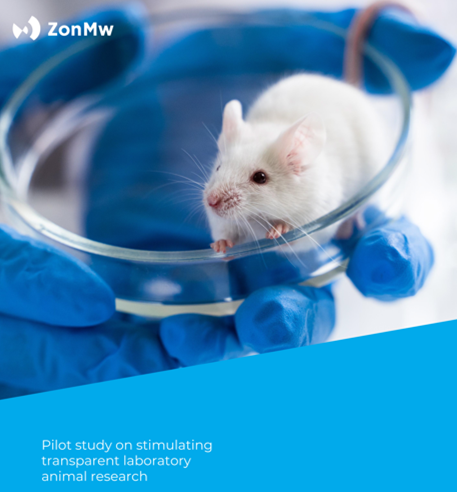
Commissioned by the Dutch Ministry of Education, Culture and Science, ZonMw conducted a pilot study from 2021 onwards to improve the transparency and quality of animal research. The study focused on measures such as the preregistration of research protocols, the use of the ARRIVE guidelines, FAIR data practices, and open-access publication. Its aim was to prevent unnecessary duplication of animal studies, improve reproducibility, and promote the 3Rs: Reduction, Refinement, and Replacement.
Committee
-
Chair
Dr Henriette BoutVice-chairman
Prof. Iris SommerMembers
Tineke Coenen de Roo
Dr Marjolein van Driel
Dr Janny van den Eijnden-Van Raaij
Dr Janine Ezendam
Dr Peter van Meer
Dr Natal van Riel
Dr Marijn Vlaming
Debby Weijers
Dr Katja Wolthers
Dr Raymond Pieters
Prof. Sabeth Verpoorte
Dr Marc van de Wetering
Dr Jelmer Wolterink
Marcel ZuijderlandObservers
Dr Erica van Oort
Dirk-Jan Saaltink


Features
- Budget: € 5.590.500
-
Duration: 63%
from
to
Duration: 63 % expired
- Related programmes:
NWA Do-ReACT
This thematic programme of the NWA is focused on the further development and validation of NAMs, which are aimed at determining the hazard and/or risk of exposure to chemical substances. The goal is to take these NAMs as far as possible towards regulatory acceptance.
View the NWA Do-ReACT programme here.
Grants
Projects
Contact
ZonMw is a partner in the national partnership Transition Programme for animal-free Innovation (TPI), which aims to play an international pioneering role for the Netherlands in animal-free innovation. The Ministry of LVVN coordinates this process together with other ministries. Various initiatives contribute to the TPI objectives, including the MKMD programme.